
Trong kỷ nguyên AI, việc tạo ra 1 bài viết Content SEO không khó, nhưng để tạo ra nội dung vừa chuẩn SEO, vừa chạm đúng nhu cầu người dùng lại là một thách thức lớn. Nếu bạn chỉ đơn thuần yêu cầu AI “viết một bài về…”, kết quả nhận được thường là những nội dung sáo rỗng và thiếu chiều sâu.
Để giải quyết vấn đề đó, team R&D của SEO Center đã đúc kết và phát triển Quy trình 7 bước viết Content SEO với AI. Đây là hệ thống giúp bạn “huấn luyện” AI trở thành một chuyên gia nội dung thực thụ. Hãy cùng khám phá chi tiết ngay sau đây!
Nội dung bài học
Bước 1: Cung cấp kiến thức nền tảng về Content SEO cho AI học
Trước khi bắt đầu viết, chúng ta cần cung cấp cho AI bộ kiến thức tiêu chuẩn để AI hiểu được thế nào là một bài viết tốt theo tiêu chuẩn quốc tế.
Chúng ta sẽ cho AI học qua 3 loại tài liệu chính bao gồm:
- Tài liệu về “Creating helpful, reliable, people-first content” của Google
- Tài liệu về “Hemingway’s 4 Fast Rules For Effective Writing”
- Tài liệu về “Google Search’s guidance about AI-generated content”
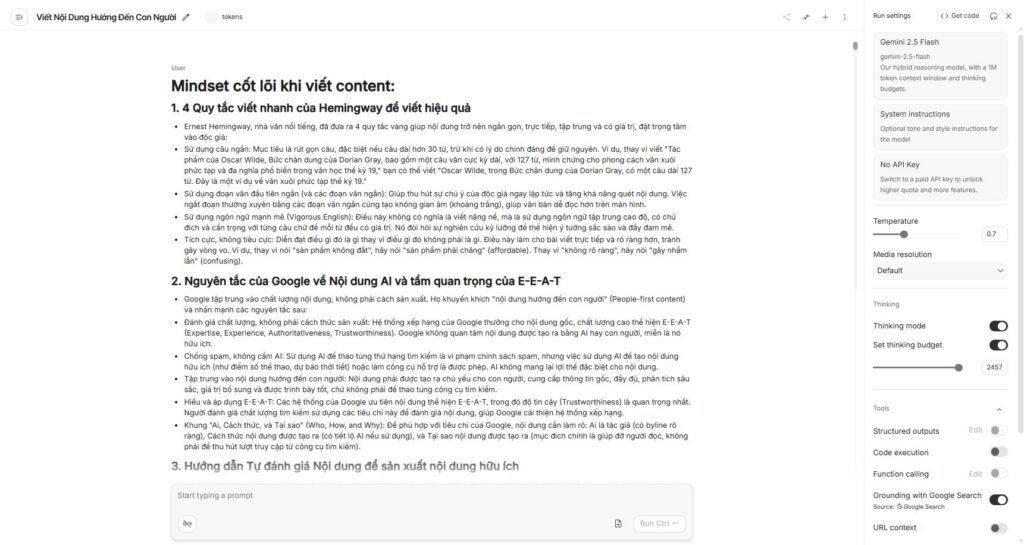
=> Hiện bộ tài liệu này đã được SEO Center phân tích, tổng hợp và sử dụng để sử dụng làm tài liệu Training nội bộ và tặng kèm trong các khóa học SEO của SEO Center.
Tuy nhiên, nếu bạn chưa thể tham gia khóa học của SEO Center thì bạn cũng có thể sử dụng Prompt dưới đây để triển khai cho AI học:
# Core Mindset for Content Writing

## 1. Hemingway’s 4 Rules for Efficient Writing

Ernest Hemingway, the world-renowned author, established four golden rules to ensure content remains concise, direct, focused, and value-driven, with a primary emphasis on the reader:

* **Use Short Sentences:** Aim to trim sentences down, especially if they exceed 30 words, unless there is a compelling reason to keep them long. For instance, instead of saying, *"Oscar Wilde’s novel, The Picture of Dorian Gray, contains an incredibly long sentence of 127 words, illustrating the complex and multilayered prose style common in 19th-century literature,"* you could write: *"In The Picture of Dorian Gray, Oscar Wilde includes a 127-word sentence. This exemplifies the complex prose of the 19th century."*
* **Use Short First Paragraphs (and short paragraphs in general):** This captures the reader's attention immediately and improves scannability. Frequent line breaks create "negative space" (white space), making the text easier to read on digital screens.
* **Use Vigorous English:** This does not mean writing aggressively; rather, it involves using highly focused, intentional language. Every word must carry weight. It requires careful research to express ideas with sharpness and passion.
* **Be Positive, Not Negative:** Describe what something *is* rather than what it *is not*. This makes writing more direct and avoids wordiness. For example, instead of saying "the product is not expensive," say "**affordable**." Instead of "not clear," use "**confusing**."

## 2. Google’s Guidelines on AI Content and the Importance of E-E-A-T

Google prioritizes content quality over the method of production. They encourage **"People-first content"** and emphasize the following principles:

* **Reward Quality, Regardless of Production:** Google’s ranking systems reward original, high-quality content that demonstrates **E-E-A-T** (Experience, Expertise, Authoritativeness, and Trustworthiness). Google does not penalize AI-generated content as long as it is helpful.
* **Anti-Spam, Not Anti-AI:** Using AI to manipulate search rankings violates spam policies. However, using AI to generate useful content (e.g., sports scores, weather forecasts) or as a supportive tool is permitted. AI does not grant a special advantage to content.
* **Focus on People-First Content:** Content must be created primarily for humans, providing original information, comprehensive analysis, and added value, rather than being designed to manipulate search engines.
* **Understand and Apply E-E-A-T:** Google’s systems prioritize content showing E-E-A-T, with **Trustworthiness** being the most critical factor. Search Quality Raters use these criteria to evaluate content and help Google improve its ranking algorithms.
* **The "Who, How, and Why" Framework:** To align with Google's standards, content should clarify: **Who** created the content (clear byline), **How** it was created (disclosure of AI use if applicable), and **Why** it was created (the primary purpose must be to help readers, not to gain search engine traffic).

## 3. Content Self-Assessment Guide for Creating Helpful Content

This guide helps creators self-audit their work to ensure it meets Google's standards for "people-first content" and avoids "search engine-first content."

* **Self-Assess Your Content:** Constantly question the quality, value, and originality of your work. Seek honest feedback from individuals unaffiliated with your website.
* **Content and Quality Questions:** Focus on providing original information, deep analysis, and significant added value compared to other sources. Titles should be descriptive and helpful, avoiding clickbait or exaggeration. Content must be produced carefully, not sloppily or through mere rewriting.
* **Expertise Questions:** Ensure the content demonstrates expertise and builds trust through clear sourcing, evidence of subject-matter knowledge, and background information about the author or the site. Content should be written or reviewed by an expert.
* **Great Page Experience:** Focus on providing a high-quality overall user experience, not just focusing on isolated technical aspects.
* **Avoid Search Engine-First Content:** Do not write content solely to attract SEO traffic, mass-produce articles, summarize others without adding value, or write about trending topics unrelated to your niche. Additionally, do not write to a specific word count thinking Google prefers it (they do not).=> Cách sử dụng:Bạn nhập bộ Prompt này vào AI để AI học qua về nội dung trong Prompt.
Bước 2: Phân tích Search Intent cụ thể theo thị trường
Ở bước này, bạn sẽ yêu cầu AI tiến hành phân tích Search Intent và nhu cầu của người dùng đối với chủ đề mà bạn đang viết. Bước này sẽ giúp cho nội dung của bạn có thể triển khai đúng trọng tâm: khách hàng muốn học hỏi, muốn mua hàng, hay chỉ đang so sánh giá?
Dưới đây là Prompt để phân tích Search Intent của người dùng:
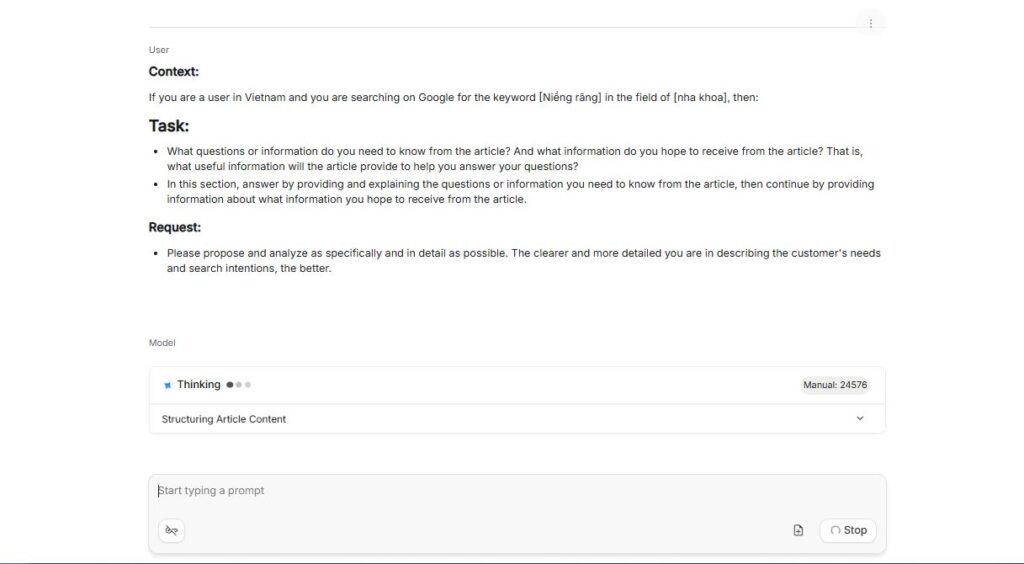
### Context:
If you are a user in Vietnam and you are searching on Google for the keyword [KEYWORDS] in the field of [Topic], then:
## Task:
What questions or information do you need to know from the article? And what information do you hope to receive from the article? That is, what useful information will the article provide to help you answer your questions?

In this section, answer by providing and explaining the questions or information you need to know from the article, then continue by providing information about what information you hope to receive from the article.

### Request:
Please propose and analyze as specifically and in detail as possible. The clearer and more detailed you are in describing the customer's needs and search intentions, the better.=> Cách sử dụng:Nhập bộ prompt này ngay bên dưới Prompt bước 1.
Bước 3: Thu thập số liệu và data thực tế về chủ đề đang viết
Điểm yếu của AI là dữ liệu có thể bị lỗi thời và không sử dụng các số liệu thực tế vào trong bài viết, khiến cho bài viết cực kì nghèo thông tin.
Vậy nên ở bước này, bạn sẽ yêu cầu AI đi Research các thông tin, số liệu, báo cáo mới nhất liên quan đến chủ đề mà bạn đang viết. Mục tiêu là AI ghi nhớ được các thông tin, số liệu này và áp dụng chúng vào trong bước viết content.
Bên cạnh đó, các số liệu này cũng sẽ giúp bài viết tăng tính chuyên môn (Expertise) và độ tin cậy (Trustworthiness) hơn trong mắt Google.
Dưới đây là Prompt để nghiên cứu thông tin, dữ liệu cho bài viết:
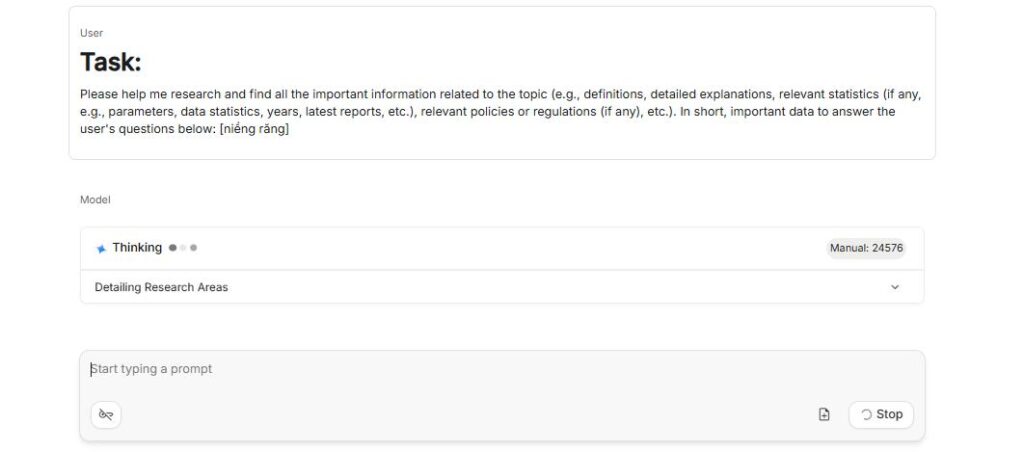
# Task:
Please help me research and find all the important information related to the topic (e.g., definitions, detailed explanations, relevant statistics (if any, e.g., parameters, data statistics, years, latest reports, etc.), relevant policies or regulations (if any), etc.). In short, important data to answer the user's questions below: [KEYWORD]=> Cách sử dụng:Nhập bộ prompt này ngay bên dưới Prompt bước 2.
Bước 4: Xây dựng bộ từ khóa cho bài viết
Để cho bài viết có thể ranking được nhiều từ khóa hơn thì bài viết của bạn cũng cần bao phủ được nhiều hơn các từ khóa phụ, từ khóa ngữ nghĩa (LSI) và các cụm từ liên quan mà người dùng thường xuyên sử dụng. Việc này giúp bài viết có cơ hội phủ sóng rộng hơn trên kết quả tìm kiếm và cũng giúp cho Google hiểu rõ hơn về chủ đề mà bạn đang viết.
Dưới đây là Prompt để nghiên cứu bộ từ khóa cho bài viết:
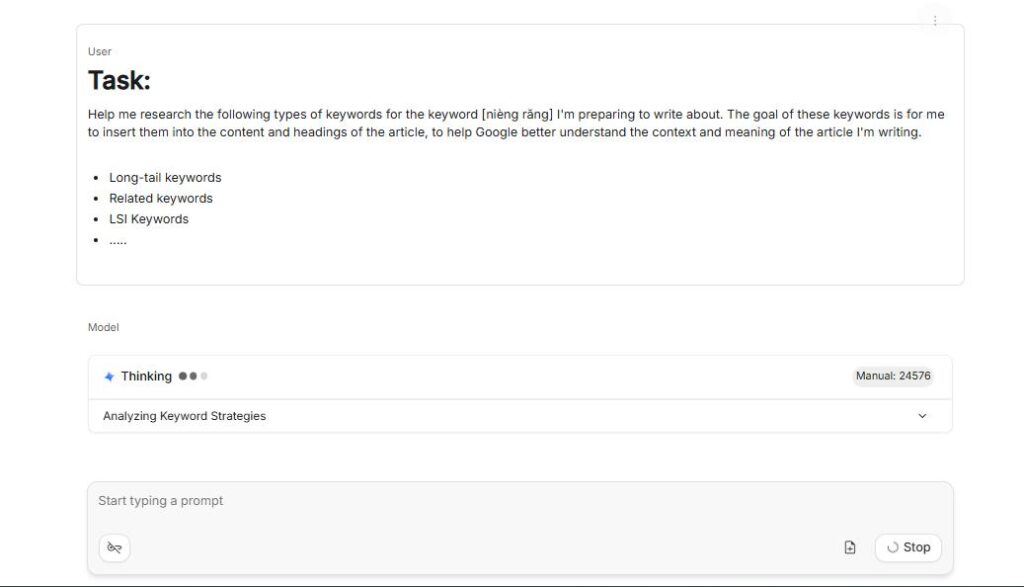
# Task:
Help me research the following types of keywords for the keyword [KEYWORDS] I'm preparing to write about. The goal of these keywords is for me to insert them into the content and headings of the article, to help Google better understand the context and meaning of the article I'm writing.

- Long-tail keywords
- Related keywords
- LSI Keywords
- .....=> Cách sử dụng:Nhập bộ prompt này ngay bên dưới Prompt bước 3.
Bước 5: Tổng hợp và phân tích nội dung của các đối thủ đang top trên Google
Sau khi đã có đủ thông tin và dữ liệu về chủ đề chính và những vấn đề mà khách hàng quan tâm, bây giờ bạn sẽ cần phải phân tích được xem các đối thủ hiện đang triển khai những nội dung gì bên trong bài viết.
Bước này bạn cần cung cấp nội dung của các bài viết đang đứng Top 1-5 trên Google cho AI đọc qua, phân tích và ghi nhớ. AI sẽ phân tích những điểm hay của đối thủ, kết hợp với dữ liệu đã research ở Bước 3 để tạo ra một nguồn tài liệu tổng hợp ưu việt, chứa đầy đủ thông tin và dữ liệu hơn bất kỳ bài viết nào hiện có trên Google.
Dưới đây là Prompt để nghiên cứu phân tích bài viết của các đối thủ đang top:
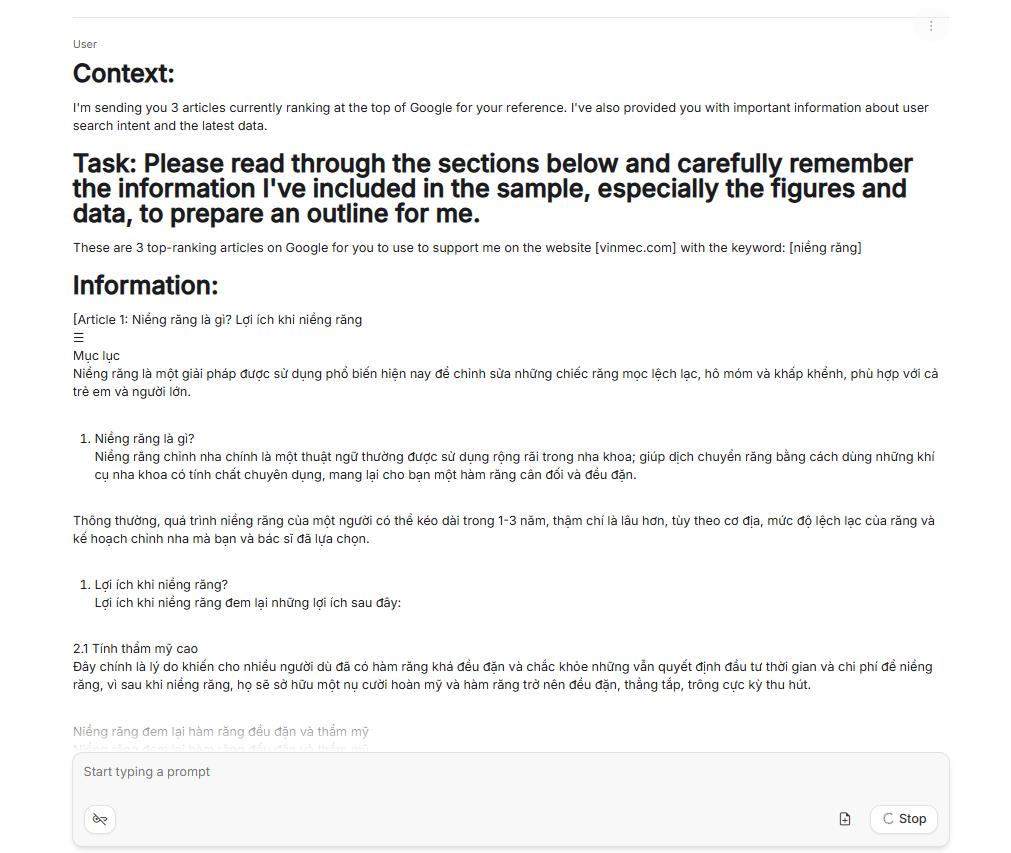
# Context:
I'm sending you 3 articles currently ranking at the top of Google for your reference. I've also provided you with important information about user search intent and the latest data.

# Task: Please read through the sections below and carefully remember the information I've included in the sample, especially the figures and data, to prepare an outline for me.

These are 3 top-ranking articles on Google for you to use to support me on the website [TÊN MIỀN CỦA BẠN] with the keyword: [KEYWORDS]

# Information:

[Article 1: ]

[Article 2: ]

[Article 3: ]=> Cách sử dụng: Nhập bộ prompt này ngay bên dưới Prompt bước 4.
Bước 6: AI Lên Outline cho bài viết theo những thông tin đã được học
Dựa trên tất cả dữ liệu đã có, AI sẽ tiến hành lên 1 bộ Outline chi tiết và đầy đủ nhất cho bài viết của bạn.
Nguyên tắc cơ bản trong bộ Outline này đã được SEO Center quy tắc là: Các thẻ Heading (H2, H3, H4,…) phải logic, bao quát toàn bộ vấn đề và chứa đựng các từ khóa quan trọng đã nghiên cứu. Vậy nên bạn có thể yên tâm 1 điều là Outline của bạn chắc chắn tốt hơn, đầy đủ thông tin hơn tất cả những bài viết hiện có trên Google.
Dưới đây là Prompt lên Outline cho bài viết:
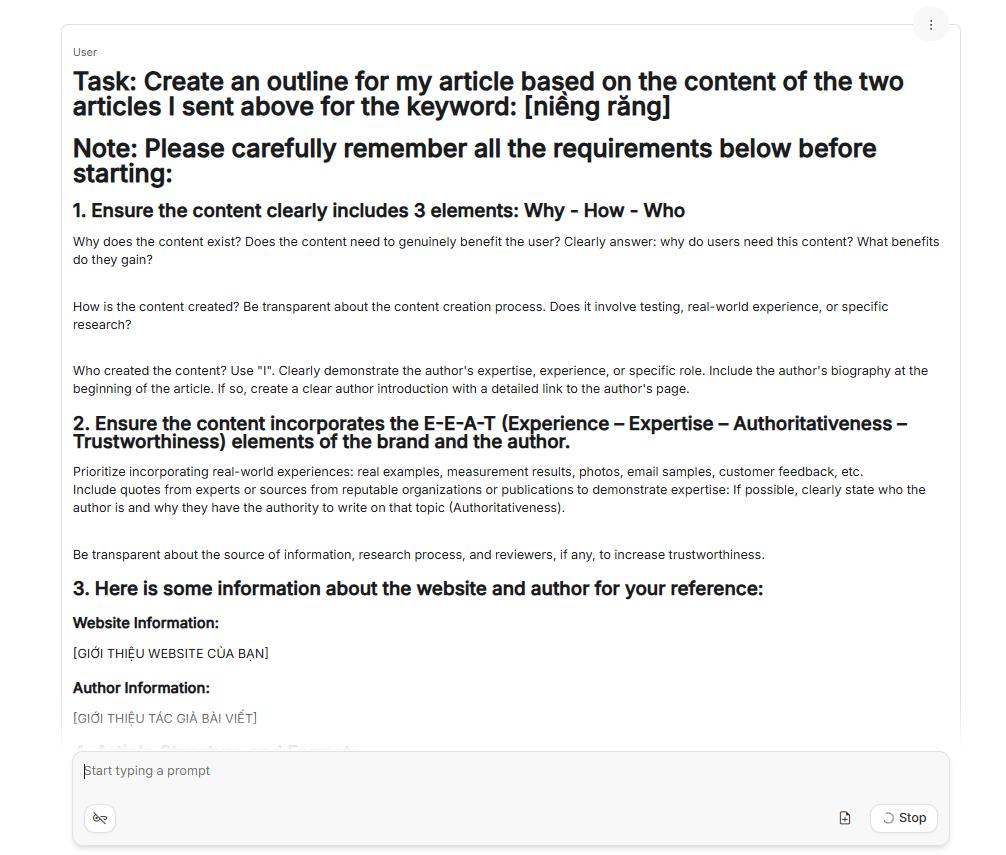
# Task: Create an outline for my article based on the content of the two articles I sent above for the keyword: [KEYWORDS]

# Note: Please carefully remember all the requirements below before starting:

## 1. Ensure the content clearly includes 3 elements: Why - How - Who

Why does the content exist? Does the content need to genuinely benefit the user? Clearly answer: why do users need this content? What benefits do they gain?

How is the content created? Be transparent about the content creation process. Does it involve testing, real-world experience, or specific research?

Who created the content? Use "I". Clearly demonstrate the author's expertise, experience, or specific role. Include the author's biography at the beginning of the article. If so, create a clear author introduction with a detailed link to the author's page.

## 2. Ensure the content incorporates the E-E-A-T (Experience – Expertise – Authoritativeness – Trustworthiness) elements of the brand and the author.

Prioritize incorporating real-world experiences: real examples, measurement results, photos, email samples, customer feedback, etc.
Include quotes from experts or sources from reputable organizations or publications to demonstrate expertise: If possible, clearly state who the author is and why they have the authority to write on that topic (Authoritativeness).

Be transparent about the source of information, research process, and reviewers, if any, to increase trustworthiness.

## 3. Here is some information about the website and author for your reference:

### Website Information:

[GIỚI THIỆU WEBSITE CỦA BẠN]

### Author Information:

[GIỚI THIỆU TÁC GIẢ BÀI VIẾT]

## 4. Article Structure and Format:

- Write an introductory paragraph (sapo) of approximately 50-100 words for a blog post using the submitted keywords. Briefly introduce the reason for writing, the main content to be covered, and finally, a natural introduction about the author. The writing style should be friendly, easy to read, not too rigid, and avoid clichés. Write as if you are speaking directly to someone curious about this article.

- The sapo and author introduction should be combined into one heading.

- Do not use dividers or icons throughout the article.

- The number of H2 and H3 subheadings should be appropriate to the researched information and should be included in the content writer's outline. These H2 subheadings must clearly explain the main keywords and content discussed in the article. H3 subheadings must also clearly, specifically, and detailedly explain the information in H2 to ensure the article is as comprehensive as possible, optimizing the semantic and informational effectiveness of the article, meeting the search intent and answering all the reader's questions.

- Mark the Headings in the Outline for easy follow-through. For example: H2: abc.... ; H3: xyz.....
- Do not number the headings and do not capitalize the entire heading tag; only capitalize the first letter of the heading.

- Before using the FAQ, add a PR Heading introducing the website/business and its services, along with a CTA.

- Include an H2 tag with 2-3 FAQ questions answering other reader questions.

- At the end of the article, there is an H2 tag listing the sources of the article, which are the URLs I sent you, and adding 1-2 more sources from well-known websites in the industry worldwide.=> Cách sử dụng:Nhập bộ prompt này ngay bên dưới Prompt bước 5.
Bước 7: AI viết Content theo từng thẻ heading của Outline
Thay vì bắt AI viết cả bài một lúc vì AI sẽ rất dễ dẫn đến mất ý hoặc nội dung không đảm bảo được tính chuyên sâu, chúng ta sẽ yêu cầu AI triển khai chi tiết từng phần Heading theo Outline ở Bước 6. Điều này đảm bảo mỗi đoạn Heading đều được viết cực kì sâu sắc, đầy đủ thông tin và tuân thủ chặt chẽ các nguyên tắc đã thiết lập ở Bước 1.
Dưới đây là Prompt viết bài Content AI theo Outline:
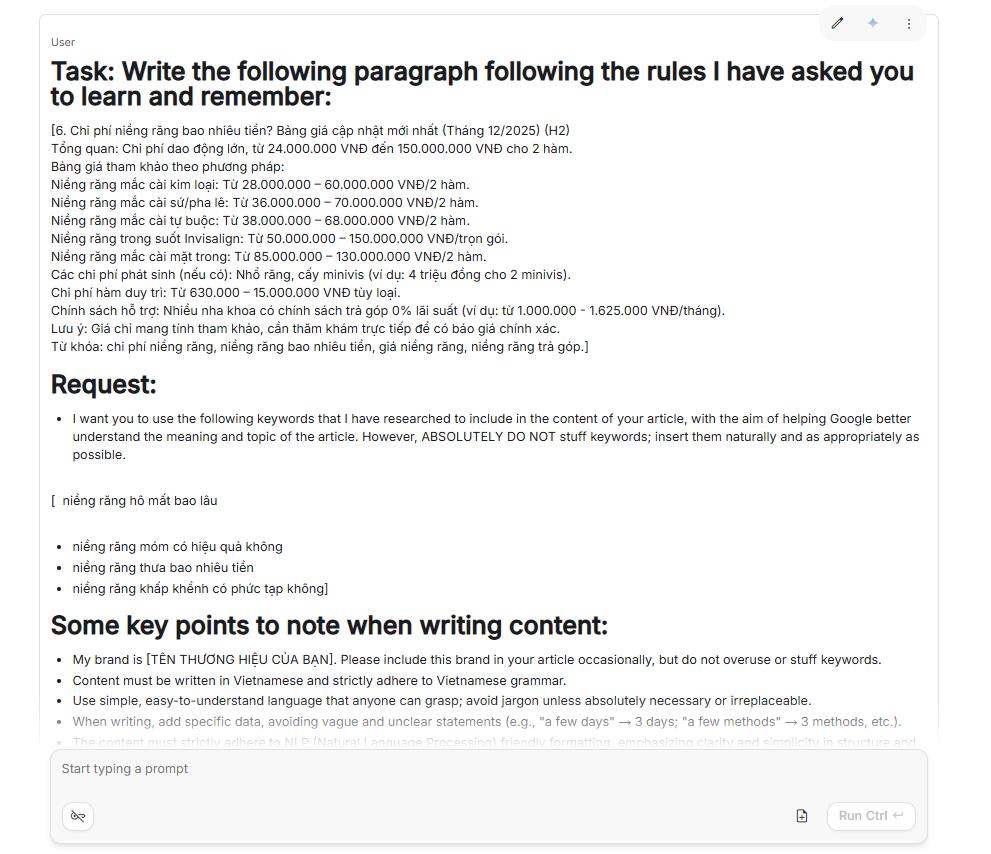
# Task: Write the following paragraph following the rules I have asked you to learn and remember:

[HEADING CẦN VIẾT]

# Request:
- I want you to use the following keywords that I have researched to include in the content of your article, with the aim of helping Google better understand the meaning and topic of the article. However, ABSOLUTELY DO NOT stuff keywords; insert them naturally and as appropriately as possible.

[TỪ KHÓA ĐÃ RESEARCH Ở BƯỚC 4]

# Some key points to note when writing content:
- My brand is [TÊN THƯƠNG HIỆU CỦA BẠN]. Please include this brand in your article occasionally, but do not overuse or stuff keywords.

- Content must be written in Vietnamese and strictly adhere to Vietnamese grammar.

- Use simple, easy-to-understand language that anyone can grasp; avoid jargon unless absolutely necessary or irreplaceable.

- When writing, add specific data, avoiding vague and unclear statements (e.g., "a few days" → 3 days; "a few methods" → 3 methods, etc.).

- The content must strictly adhere to NLP (Natural Language Processing) friendly formatting, emphasizing clarity and simplicity in structure and language. Ensure sentences follow the subject-predicate-adverbial-object order and adhere to standard Vietnamese grammar.

- The content must be concise, simple, and directly address the issue, strictly adhering to the "Hemingway Rules for Content." ABSOLUTELY DO NOT write rambling, lengthy texts that provide no value, information, or data to the reader. This method aims to help search engines understand the content faster, while minimizing reader time and still allowing them to find answers to their questions.

- While prioritizing NLP-friendly content (90%), also dedicate (10%) of your focus to making content engaging and interesting for readers, balancing NLP optimization with reader satisfaction to create content that not only ranks well on search engines but is also appealing and valuable to readers.

- Incorporate real-world stories or examples into your content as if you were sharing information with a friend, helping them better understand the topic.=> Cách sử dụng:Nhập bộ prompt này ngay bên dưới Prompt bước 6. Cứ lặp lại bước này liên tục cho đến hết bài viết là được.
Dùng AI nào để viết Content SEO?
Bạn hoàn toàn có thể sử dụng bất cứ AI nào, bao gồm ChatGPT, Gemini, Claude, AI Studio,…. để viết bài content SEO. Nhưng Gemini và AI Studio là 2 AI có khả năng viết bài tốt nhất hiện nay.
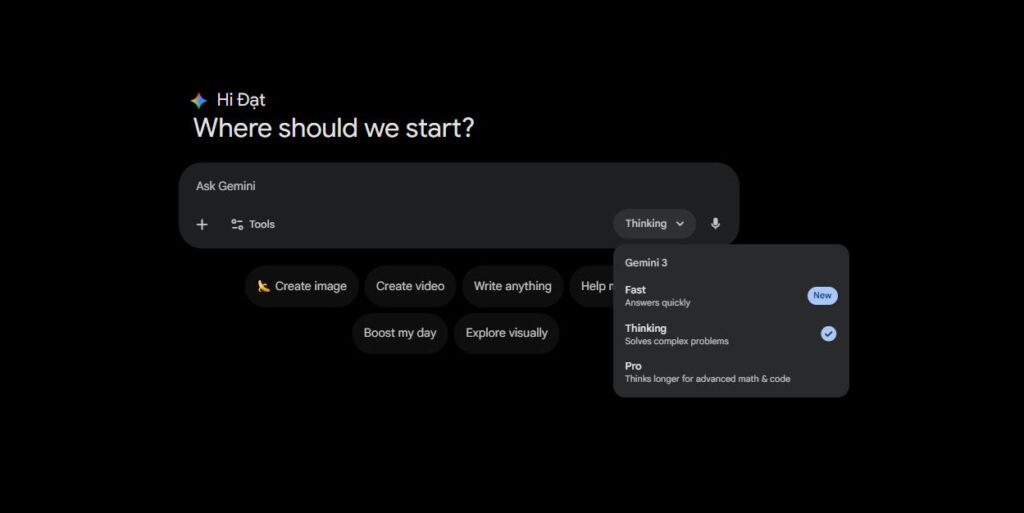
Với Gemini bản mới nhất, bạn nên chọn vào chế độ thinking để tối ưu nhất được khả năng suy luận và khả năng viết của AI này nhé.
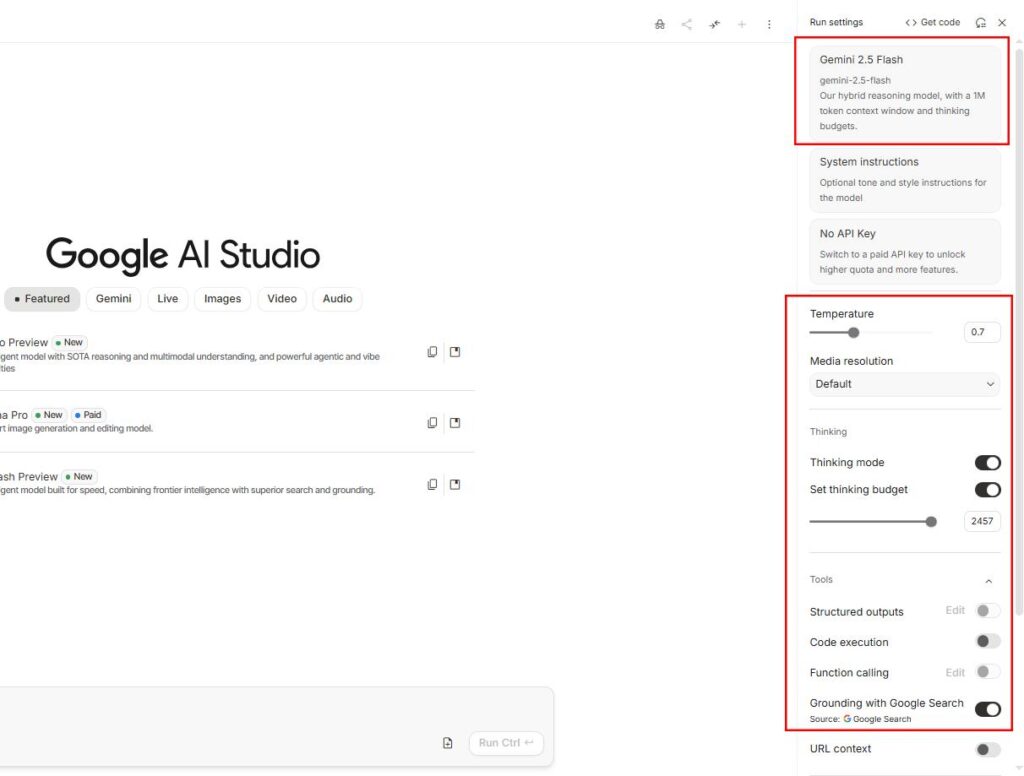
Còn đối với AI Studio, bạn sẽ cần chỉnh 1 chút cấu hình như sau để chất lượng nội dung được tốt nhất:
- Model: Gemini 2.5 Flash
- Temperature: 0.7
- Thinking Mode: On
- Set Thinking Budget: On và kéo max token
- Grounding with Google Search: On
- Top P: 0.7
Dùng AI viết Content SEO có bị Google phạt không?
KHÔNG, Google không phạt nội dung chỉ vì nó được tạo ra bởi AI.
Google đã khẳng định trong các tài liệu hướng dẫn (Search Central) rằng: Họ ưu tiên nội dung hữu ích và có chất lượng cao, bất kể nó được tạo ra bởi con người hay máy móc.
- Nếu AI viết bài giúp người dùng giải quyết vấn đề: Bài viết sẽ được xếp hạng cao.
- Nếu AI viết bài chỉ để “nhồi nhét từ khóa” và thao túng thứ hạng: Bài viết sẽ bị coi là Spam.
Google sử dụng hệ thống SpamBrain để quét và xử phạt các trang web vi phạm các lỗi sau:
- Lạm dụng nội dung quy mô lớn: Dùng AI để sản xuất hàng nghìn bài viết mỗi ngày một cách cẩu thả, không có sự kiểm soát của con người.
- Nội dung mỏng: Bài viết chung chung, không có thông tin mới, chỉ xào nấu lại những gì đã có trên mạng.
- Thiếu độ tin cậy E-E-A-T: Bài viết chứa thông tin sai lệch, số liệu cũ hoặc không có bằng chứng về sự trải nghiệm thực tế.
Quy trình 7 bước của SEO Center chia sẻ ở trên đã được thiết kế rất thông minh nhằm “lách” qua các bộ lọc của Google vì:
- Bước 3 (Research số liệu/data): Giúp bài viết có tính Expertise (Chuyên môn) và Trust (Độ tin cậy), điều mà AI thuần túy thường làm kém.
- Bước 2 (Search Intent): Đảm bảo bài viết phục vụ đúng nhu cầu người dùng, đáp ứng tiêu chí Helpful Content.
- Bước 5 (Tổng hợp bài Top): Giúp nội dung của bạn có tính cạnh tranh cao hơn các bài viết hiện có.
Tuy nhiên, để đảm bảo 100% không bị phạt, bạn nên:
- Kiểm chứng thông tin: AI thường xuyên “chém gió” vậy nên bạn phải là người check lại số liệu.
- Thêm trải nghiệm cá nhân: Google rất thích yếu tố Experience, Chữ E đầu tiên trong E-E-A-T. Vậy nên bạn hãy thêm các ví dụ thực tế mà bạn đã trải qua.
- Biên tập lại giọng văn: Đừng để nguyên văn phong của AI. Hãy dùng quy tắc Hemingway để làm cho bài viết sắc sảo hơn.
Dùng AI viết content được không?
Bạn hoàn toàn có thể dùng AI viết content
Kết luận
AI là công cụ hỗ trợ tuyệt vời để viết Content SEO ngày nay. Nếu bạn dùng AI để viết nội dung tốt hơn, bạn sẽ lên Top. Nếu bạn dùng AI để viết nội dung nhiều hơn nhưng kém chất lượng, bạn sẽ bị phạt và không thể cải thiện được hiệu quả.
Hy vọng qua bài viết trên, SEO Center đã giúp bạn nắm rõ được quy trình triển khai 1 bài viết Content SEO chuẩn nhất mà không lo bị Google phạt. Nếu bạn còn thắc mắc gì trong việc triển khai SEO website với SEO thì hãy liên hệ đến SEO Center để được tư vấn trực tiếp nhé!